
FAQs
You asked, we answered. Have questions about pet risks, Pet Care Insurance (PCI), or how business insurance works for pet care? You’re in the right place. Find out why you should try PCI, or check out the questions below from pet care pros like you.
What-If Coverage Scenarios
What happens if a pet gets sick or injured while in my care?
Every PCI policy includes two coverages made for this exact moment — one that can help with the vet bill no matter who’s at fault, and another that can help with a broader range of costs if you’re held responsible for the pet getting hurt. Which kicks in depends on the situation, and we break down the differences in the next question.
Curious what real pet injury claims and payouts look like? Our Pet Protection and Veterinarian Reimbursement pages cover real stories of pet pros we’ve helped when a pet got hurt.
Pet Protection (Animal Bailee) vs Veterinarian Reimbursement: which one pays when a pet gets hurt?
The easy way to remember it: Veterinarian Reimbursement can cover an emergency vet bill no matter who’s at fault, and Pet Protection has your back when you’re legally on the hook for a hurt or lost pet. Both coverages are included in every policy, but you can add higher limits to either for an extra cost. One (or both) could help you handle claims when a pet gets hurt, depending on the situation.
Here’s the breakdown:
| Veterinarian Reimbursement | Pet Protection (Animal Bailee) | |
|---|---|---|
|
When it helps |
A client’s pet gets sick or hurt in your care and needs a vet |
You’re found legally responsible for a pet in your care getting injured, sick, lost, or worse |
|
Does fault matter? |
No — it can pay regardless of who’s at fault |
Yes — it applies when you’re legally on the hook |
|
What it can pay for |
Emergency vet bills |
A broader range of costs: vet care, legal fees if you’re sued, and more |
|
Per-incident limit |
Up to $1,000 |
Up to $2,500 |
|
Yearly limit |
Up to $2,500 |
Up to $5,000 |
|
Deductible |
$250 per incident |
None |
|
Waiting period |
7 days before it’s active |
7 days before it’s active |
|
In every policy? |
Yes — add higher limits for an extra cost |
Yes — add higher limits for an extra cost |
What if a pet escapes or gets lost on my watch?
If a pet in your care slips out the door or snaps their leash, Pet Protection (Animal Bailee) Coverage is designed to help with what comes next, like the cost of a search or a claim if you’re held responsible for the escape. Insurance can’t chase down a runaway Collie for you, but it can help keep a stressful moment from turning into a stressful month.
What if a pet in my care bites or hurts someone?
If a pet in your care hurts a person or another pet, General Liability Insurance is built to help. Every PCI policy includes an Animal Liability Limit of up to $100,000 per incident and $200,000 per year for animal-related injuries — that includes pet-on-person and pet-on-pet injuries, like bites, scratches, knock-downs, trips, and collisions.
Two key facts to know:
- Your policy covers your responsibility for injuries to other people (like clients and bystanders), not to yourself or your team. To cover yourself, you’d need personal health insurance. To cover your employees’ injuries, you’d need Workers Compensation.
- PCI can’t cover pets with a history of aggression or a “dangerous dog” designation from local authorities. Not sure how to ask clients for a pet behavior history? See our bite history glossary entry or bite history checklist for some tips to make asking consistent and painless.
What if I damage a client’s home or their belongings?
A wagging tail collides with a full coffee mug on a low table, and suddenly there’s a bill. It could happen to anyone, so PCI offers multiple ways to cover the risks that best match your pet care business:
- General Liability (included with every policy) is designed to help with damage to a client’s property. This covers the permanent stuff, like their house, fixtures, yard, or driveway. So, if a client’s dog scratches their floor during your drop-in, this coverage could help pay for repairs.
- Broadened Property Damage Coverage (an optional add-on coverage) can help pay for damage to a client’s personal belongings, like furniture, decor, or pet accessories. It’s made for in-home pet sitters, dog walkers, trainers, mobile groomers, and other pros who work in spaces they don’t own.
Both can protect you whether you or a pet caused the damage.
Are my own pets covered, or just my clients’ pets?
PCI coverage is built for protecting the pets you care for as part of your business, meaning your clients’ pets in your care, custody, or control. To cover vet costs for pets you own, you would need a different kind of insurance coverage, called pet health insurance.
If you’re not sure how this would apply to your specific setup (for example, you use your own dogs to socialize clients’ dogs during training), our licensed support team is always happy to talk it through.
What if something happens while I’m walking or training a dog off-leash?
On or off the leash, PCI coverage is designed to follow your pet care services. We don’t have any specific leash rules required for coverage. As always, use your best professional judgment to stay within a pet’s known limits, and follow local leash laws and your clients’ instructions.
Who’s Covered?
Are my employees or independent contractors automatically covered by my policy?
No, employees and independent contractors must be added to your policy to be covered. You can do that by buying Employee and Independent Contractor Coverage, which allows you to list team members by name for coverage on your policy. You pay per employee, so your price reflects the actual size of your team. Add them when you buy your policy, or add new employees anytime from your dashboard.
Which type of employees need this coverage:
- Needs Coverage: Any full-time or part-time employee, seasonal help, or contractor hired to work directly with pets and customers.
For example: You hire three contractors as dog walkers to help you handle more bookings. You need to add all three to your policy with Employee and Independent Contractor Coverage for their work to be covered.
- Doesn’t Need Coverage: Admin or support staff who don’t work directly with pets and customers.
For example: Your board-and-groom business hires Anthony to handle payroll in the back office. He doesn’t work with pets or clients, so he doesn’t need coverage for pet care under your policy.
What does “bonded and insured” mean?
“Bonded and insured” means a pet pro bought business insurance plus a fidelity bond. If your employee steals from a client, the bond can pay the client back, helping you handle a stressful situation quickly and professionally. A bond may make clients feel more comfortable trusting someone they don’t know in their home, but it’s just for dishonest acts. Business insurance is your coverage for your actual pet care service.
Does PCI offer bonding?
PCI offers Employee Dishonesty Insurance, which is similar to bonding and typically fulfills the same requirements, but is often better for you as the pet care business owner. We break down the differences and how to add it to your policy on our Employee Dishonesty Insurance page.
Are my family members covered if they help me with pet care?
Your PCI policy can protect family members who help you with pet care gigs, if they meet some conditions. The policy will cover your spouse and kids under 18 years old, as long as they’re carrying out pet care work you were hired to do. This is a good one to talk through with our customer support team if you have questions about your specific situation.
What if I get hurt on the job?
Your policy is designed for pet care business liability, which means it helps keep you from getting stuck with the medical bills if someone else (like a client or bystander) gets hurt in relation to your pet care. It isn’t built to cover your own injuries, though — that’s personal health insurance.
What kinds of animals does PCI cover?
PCI is designed to cover caring for common pets kept for companionship. That means pet dogs and cats, naturally, but also rabbits, birds, fish, most rodents, and many common reptiles and amphibians. Where it stops is animals that carry different risks than the typical pet. We don’t cover livestock and farm animals, animals not commonly kept as pets, or any animals kept for breeding or commercial reasons.
See a list of common animals we cover and don’t cover in our FAQ blog, or check our exclusions page.
Are rescue or foster animals covered?
PCI covers your clients’ rescue and foster animals just like we would any client’s pet in your care, custody, and control. But if you ever decide to add a foster-based rescue operation or animal rescue coordinating as a service, we wouldn’t be able to cover that part of your business, since it involves some different risks.
We love that you’re advocating for animals, so we want you to be clear on what your coverage does and doesn’t include. Questions? Talk to our customer support team.
Are there any dog breeds you don’t cover?
No, PCI doesn’t have any breed restrictions. Individual dogs with a history of aggression (such as biting or injuring other pets or people) will not be covered under a PCI policy, but we don’t consider any dog “aggressive” just because of its breed. We see dogs as individuals, too, so behavior matters most.
Is My Type of Work Covered?
Do I need more than one policy if I offer multiple pet services?
No, one policy is usually all it takes. When you apply, select all the pet care services you actually offer. We’ll build a policy to cover that combination for you, then give you options to customize. Your coverage follows the services you tell us about, so listing all of them is what keeps every part of your business protected.
Already a PCI policyholder, but you’re adding a new pet service? Update your policy to match through your user dashboard by going to “Manage Policies” and “Change Policy Options”. We explain how to choose a policy to cover multiple services with an easy chart in our FAQ blog.
Do I still need my own insurance if I work through Rover or Wag?
Yes. Platforms like Rover and Wag tend to offer limited protection for pet caregivers (or none at all), leaving serious gaps that could stick you with costs like vet bills, medical payments, and repairs. Having your own PCI policy means your coverage follows you, not your bookings. See how PCI coverage works for Rover caregivers in Insurance for Rover Professionals.
Is there a limit to the number of pets I can care for at one time? When does it apply?
Yes, the PCI base policy for every type of pet business is designed to cover caring for up to five pets at once. That limit usually comes into play with services like group walks, daycare, or boarding, especially as your business and team start growing.
Need to cover more pets at the same time? Reach out to us for a custom quote on coverage that fits how you really operate.
Can I get covered if I’m part-time or still in training?
Absolutely. Whether pet care is a side gig, a brand-new venture, or something you’re apprenticing or training for, PCI is designed to meet you where you are and grow with you. Plenty of side-hustling or aspiring pet pros start with a PCI base policy (like our pet groomer insurance or dog trainer insurance), then customize it as they offer more services or gain clients.
Is dog training covered?
Yes, for most everyday dog training needs, and in any humane, legally compliant training method. Most obedience training and behavior work, like teaching basic commands, polishing leash manners, crate training, and generally helping dogs grow into better companions all fit comfortably under a PCI policy.
There are a few training specialities that PCI does not cover, including:
- Training guard, attack, fighting, hunting, or protection dogs
- Training service or therapy dogs
- Practice or participation in any athletic contest, exhibition, activity, game, or sport
- Training individual dogs with a history of aggression, meaning violent behaviors like biting that have resulted in injury to a person or pet in the past
- Training individual dogs with a “dangerous dog” designation from local authorities
- Training a pet with an aggressive problem behavior, like violent resource guarding or violent dog-on-dog reactivity, as your canine client for those needs usually has a history of aggression that prompts training
If your training niche lands somewhere in between, or you want to check a specific training plan, ask a customer support agent. We want you to be confident that your coverage is a good fit for how you train.
Is house sitting covered?
Yes, house sitting is covered when it goes hand-in-hand with caring for pets. You qualify for house sitting insurance if less than one-fourth of your annual revenue comes from house sitting without a pet present. We’re all about pets at PCI, so we’re probably not the right fit if you rarely care for animals.
Is transporting pets covered? What about flying with pets?
Yes, PCI is designed to cover:
- Pet taxis (driving to appointments or around town)
- Pet transporters (longer hauls between cities or states)
- Flight nannies (flying with pets within the U.S. and its territories)
Our Pet Taxi Insurance page walks through how to qualify with a safe transport setup. A quick reminder: this coverage protects the pets you’re transporting, not your vehicle. For that, you need to add Commercial Auto Insurance.
Pet Taxi Insurance vs. Commercial Auto: Does having a pet taxi policy mean my vehicle is also covered?
No, but you can protect both your pet transportation business and your vehicle through PCI. Here’s how it works:
| Pet Taxi Insurance | Commercial Auto Insurance | |
|---|---|---|
|
What it covers |
The pets you’re transporting |
Your vehicle |
|
Pets in your care while riding |
Covered, plus your responsibility for their care
|
Not covered |
|
Your vehicle |
Not covered |
Covered (damage to your car) |
|
On-road accident liability (property damage or injury) |
Not covered |
Covered |
Think of it this way: Pet Taxi Insurance looks after the passengers, Commercial Auto looks after the car. This Pet Taxi Insurance vs Commercial Auto comparison breaks down what each type of insurance covers, and how they work together for comprehensive protection.
Insurance Cost, Payments, & Renewals
How much does PCI cost, and can I pay monthly?
Pet care business insurance with PCI starts at $17.92/month or $194/year. And yes, you can absolutely pay monthly — just choose it at checkout. You’ll pay your first and last month up front (plus any applicable taxes), and there’s a small fee of $1.75 for monthly payments.
- Choose monthly for bite-sized payments that make insurance more manageable
- Choose annual to save around 10% on your yearly insurance cost
How do I get a PCI policy?
You can buy your coverage online in minutes:
- Go to our online application
- Choose the coverages you want
- Tell us a little about your business
- Get your instant quote
- Enter your payment info
And voila, you’re covered and back to making tails wag. You can access your proof of insurance (COI) in your user dashboard as soon as your payment clears.
Note: Veterinarian Reimbursement and Pet Protection have a seven-day waiting period before they’re active.
Does my policy auto-renew, or how do I renew?
Your policy can auto-renew, but it’s up to you.
- Sign up for EZ-Renew in your dashboard to renew your policy automatically, so there’s nothing to remember and no gap in your coverage. We’ll also send you a reminder that your renewal is coming up, so you still have a chance to make changes to your policy first.
- Renew manually by logging into your dashboard before your renewal date, opening “My Policies”, and clicking “Renew” next to your expiring policy. This is a smart time to make changes if you added or subtracted any services, employees, or locations this year.
Heads up: that “Renew” button in your online dashboard appears within 30 days of your expiration date, so if you don’t see it yet, you’re just a little early. We’ll send you a reminder email at the 30-day mark.
Why did my price change when I renewed my policy?
A renewal price shift could happen for several reasons, but it’s not a penalty aimed at you. Your insurance price could have changed at renewal because:
- You added a service, an employee, or adjusted your coverage. Anytime you add more coverage, your price will likely go up to reflect that you have more to protect.
- You had a claim or multiple claims last year. Claims don’t always increase your insurance cost, but some types of claims can mean higher coverage prices next year.
- A specific type of coverage increased its price, or prices increased overall. Insurance costs change over time across the whole pet business industry, shaped by things like the rising cost of vet care and broader claims trends. We try to keep price increases to a minimum at PCI so quality coverage stays accessible to as many pet pros as possible.
We aim to keep pricing as clear as we can, because we know every dollar counts. If anything about your renewal doesn’t add up, please reach out to our customer support team. We’re always happy to walk through your specific policy with you.
Do claims affect my renewal?
Your policy is there to be used when you need it, and filing a claim is exactly what it’s for. For renewal decisions and pricing, PCI looks at the bigger picture rather than only if a pet business filed any claims. That way, your renewal is tailored to your specific business and situation. If you ever have questions about renewal or how a renewal premium was calculated, our team is here to talk it through.
Can I get a refund if I don’t need my policy anymore and want to cancel?
Some of the fees tied to your policy aren’t refundable. But if you end your policy early because you no longer need the coverage, you may get back your unearned premium. That refund is calculated on a pro rata basis, which just means it’s based on how much coverage time you didn’t use.
How do I cancel my policy?
Most customers can cancel right from their online dashboard. Our step-by-step cancellation guide walks you through how to do it. If you’d rather have help, our team is a call or email away.
Claims & Getting Help
How does the claims process work if something goes wrong?
If something goes wrong during pet care, here’s how to report it and what happens next:
- If you’re not sure it needs coverage: talk to our support team. We can tell you whether you need to file a claim.
- If you already know you need coverage: file a claim.
- Your claim goes to a claims professional, who reviews what happened.
- Someone from our team will get in touch within 1-2 business days to walk you through next steps.
The sooner you report an accident, the faster our carrier can get to work making things right. Timing is key, so let us know about a problem within 10 days of the accident or when you first become aware that something went wrong, even if you don’t have all the details yet. For more about reporting a pet care accident, see our first notice of loss page.
How do I file a claim?
It’s quick and easy to file a claim if you have a PCI policy:
- Log in to your user dashboard
- Locate the “Manage Policy” section
- Click “File a Claim”
- Fill out the form and submit
Does my policy have a deductible?
Mostly, no. Your General Liability coverage, the core of your policy, doesn’t have a deductible, so there’s nothing to pay out of pocket before it responds.
The one place a deductible does apply is Veterinarian Reimbursement, which has a $250 deductible per incident. So, if a client’s pet gets hurt, you pay the vet upfront, then file a claim with us. The first $250, your deductible, is your responsibility, but Vet Reimbursement can pay back any eligible costs beyond that up to your $1,000 limit.
Can I talk to a real person if I need help?
Yes, you can! When you’re stressed, support from an actual human counts. Call us at 844.520.6990 Monday through Friday 6:00 am to 6:00 pm Mountain Time. Our full-time team is made up of U.S.-based, licensed customer support agents who know pet care risks and pet business insurance.
Have a quick question or need an after-hours answer? Ask the chatbot on our site, or email us at info@petcareins.com.
Certificate of Insurance (COI) & Additional Insureds
How fast can I get a certificate of insurance (COI)?
Right away. The moment your policy is active, your COI is ready to download from your dashboard. Need it again later? It’s always ready to adjust or download in your user dashboard under “Download Documents”.
How do I add a client, a landlord, or someone else as an additional insured?
Adding an additional insured is easy — you can do it yourself online, anytime, in less than a minute:
- Log into your user dashboard.
- Go to the “Manage Policy” section and click “Add Additional Insured”.
- Fill out the details about them and click “Confirm Additional Insured.”
If you’d like to see how it’s done, here’s a short walkthrough video.
Being added as an additional insured is often what a landlord, facility, or client is asking for when they want to be “named on your policy.” Not sure who qualifies as an additional insured or when you should add one? Read our glossary entry on additional insureds.
Is there a cost to add an additional insured?
It costs $10 to add the first additional insured, but you can add unlimited additional insured to your policy for free for the rest of your policy term. You can add additional insureds anytime through your user dashboard.
Will PCI coverage meet my client’s, landlord’s, or platform’s insurance requirements?
In most cases, yes! PCI is built around the coverage pet care pros are typically asked to carry, so it generally satisfies what clients, landlords, apartment communities, and booking platforms request, especially once you add them as an additional insured.
Check the specific limits or wording they need, and if you’re ever unsure whether your policy meets the requirements, send it our way and we’ll help you confirm.
Policy Basics & Managing Your Account
How long does my policy last?
A full year. Every PCI policy runs for 12 months, with your exact start and end dates listed on your proof of insurance in your online dashboard.
Can I change my coverage limits or add/change coverage after I buy?
Yes, your policy is designed to be flexible and grow with you. You can adjust some coverage limits up or down, or add coverages for new services or employees after you’ve bought your policy. Just log in to your user dashboard or reach out to our team for help making the change.
How do I access my policy documents?
Log in to your user dashboard 24/7 to find everything you need, including proof of insurance and policy details ready to download or view whenever you need them.
What’s my policy number, and where do I find it?
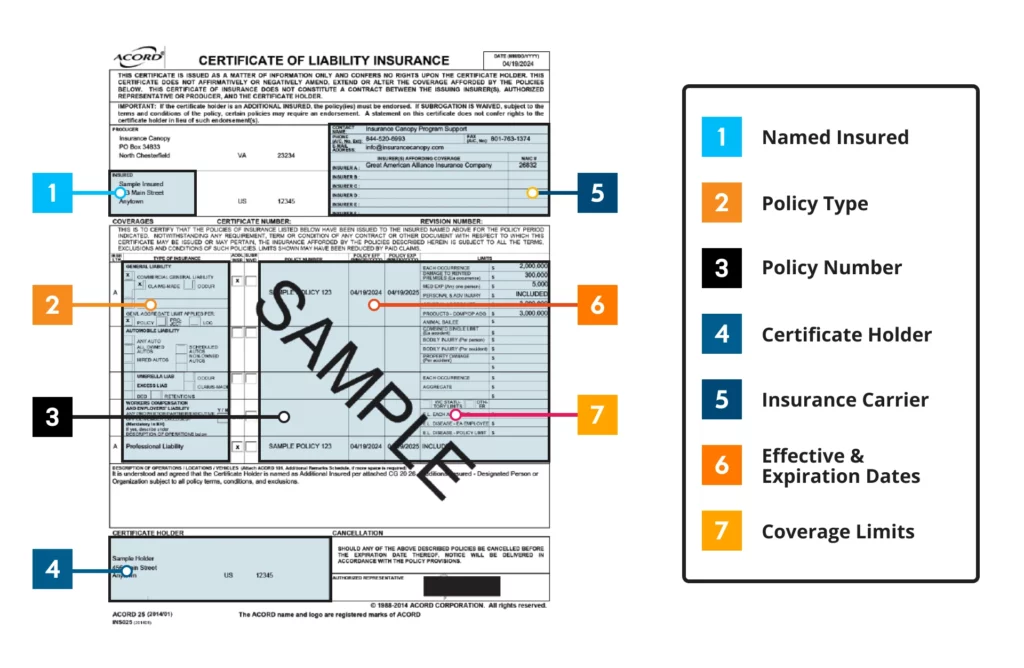
Your policy number is your coverage’s ID number, so you might need it if you have to file a claim. Your policy number is on your certificate of insurance (COI). Here’s how to find it fast:
- Log in to your user dashboard
- Navigate to “Download Documents”
- Click on “Proof of Insurance” to view your COI
- Look in the Policy Number box on your COI (it’s #3 in the labeled COI below).
Not seeing your question? Read more answers to your most-asked pet care insurance questions from social media.